
What is a Free Radical Anyway?
If you have been following Potency No. 710 on social media for any amount of time, chances are you have

Spiderweb wrinkling is one of the most frustrating skin concerns because it doesn’t behave like traditional wrinkles. These fine, crisscrossing lines often appear suddenly, catch the light at certain angles, and seem to show up overnight, even in people who don’t consider their skin “aged.” Many mistake them for dehydration alone, piling on hydrating serums and hoping for relief, only to find the effect is temporary at best.
The truth is, spiderweb wrinkling is not caused by a single issue. It’s a visible signal that several foundational skin systems are under strain at the same time. Understanding why it happens is the first step toward actually correcting it, rather than masking it for an hour or two.
This type of wrinkling is best understood as a structural and communication issue, not just a moisture problem.
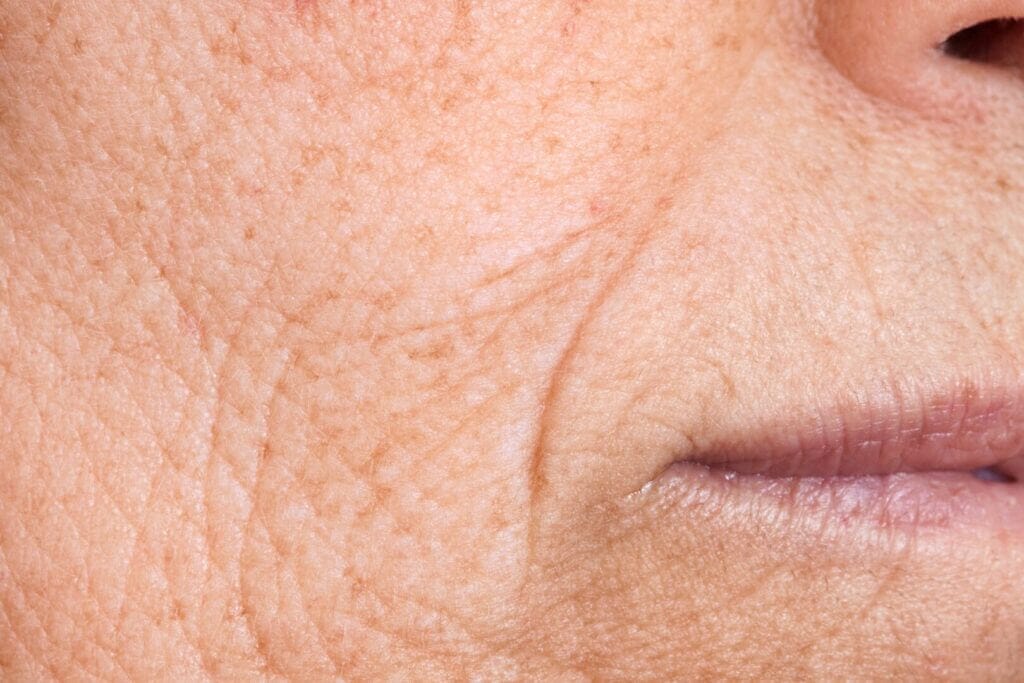
Unlike deeper expression lines or volume-loss wrinkles, spiderweb wrinkling forms when the skin loses its ability to flex, cushion, and rebound smoothly. Instead of moving as a unified surface, the skin begins to crease along micro fault lines. These lines may soften temporarily when water is added, but they reappear quickly because the underlying support system hasn’t been restored.
Spiderweb wrinkling tends to show up most often:
What looks like “sudden aging” is usually the moment when the skin crosses a threshold it’s been approaching for a while.

Spiderweb wrinkling is rarely caused by just one factor. It’s almost always a combination of the following processes happening at once.
Healthy skin relies on a complex oil matrix made up of ceramides, fatty acids, and cholesterol. This lipid layer acts as a cushion, giving skin softness, flexibility, and resilience. When that matrix thins, the skin loses its natural padding.
Without enough lipids:
This is why people often notice spiderweb wrinkling after over-cleansing, aggressive exfoliation, or long-term use of products designed to “strip oil.”
The skin barrier’s job is to regulate what gets in and what stays out. When it’s compromised, water escapes faster than the skin can replace it. As hydration drains away, the skin loses elasticity and begins to crease rather than flex.
When the barrier is impaired:
This is a major reason spiderweb wrinkling often worsens in winter, after sun exposure, or during periods of hormonal fluctuation.
Inflammation doesn’t always look red or irritated. Often, it’s subtle and ongoing, just enough to interfere with normal skin function. Chronic low-grade inflammation tightens tissue at a microscopic level, reducing suppleness and increasing surface fracture.
Inflammation can be triggered by:
As inflammation persists, fine lines don’t just form, they multiply.
One of the most misunderstood aspects of spiderweb wrinkling is the role of dehydration. Skin can be oily and dehydrated at the same time. Dehydration refers to a lack of water inside the skin, not a lack of oil on the surface.
Spiderweb wrinkling often appears when:
This is why simply adding more hydrating serums rarely solves the problem.

This is where many skincare routines fall short.
Hydrating ingredients like hyaluronic acid are excellent at drawing water into the skin. But without adequate lipids and a healthy barrier, that water has nowhere to stay. The result is temporary plumping followed by collapse.
Hyaluronic acid alone:
This explains why so many people report the same experience: “My skin looks better for an hour, then worse than before.”
Spiderweb wrinkling requires more than moisture. It requires:
Without these elements, hydration becomes a short-lived illusion rather than a solution.

Skin doesn’t just need to be filled, it needs to be calmed and guided.
Certain botanicals and phytocomplexes interact with the skin’s signaling pathways, helping regulate inflammation, supporting lipid balance, and encouraging more youthful behavior at the cellular level. Rather than forcing change, these compounds help skin return to a state of balance.
When the right plant compounds are present, skin doesn’t just appear smoother, it relaxes.
Relaxed skin moves better. It holds water more effectively, and it doesn’t fracture into spiderwebs.
This is a critical distinction. The goal isn’t to temporarily blur lines, but to support the systems that prevent them from forming in the first place.
Many people describe spiderweb wrinkling as something that suddenly appeared, seemingly out of nowhere. In reality, it’s usually the visible tipping point of accumulated stress.
This moment often follows:
The skin crosses a threshold where its compensatory mechanisms can no longer keep up. What you see is not sudden damage, but delayed visibility.
Correcting spiderweb wrinkling isn’t about aggressive resurfacing or constant exfoliation. In fact, those approaches often make it worse. Recovery comes from restoring balance.
Skin needs:
When these elements are present consistently, the skin regains its ability to flex, rebound, and retain moisture naturally.
Youthful-looking skin isn’t defined by the absence of lines, it’s defined by movement, resilience, and adaptability. Skin that behaves younger responds to stress more efficiently, recovers faster, and maintains its internal balance longer.
Spiderweb wrinkling is not a failure. It’s feedback.
It’s the skin asking for support, not suppression. And when that support is delivered correctly, the surface doesn’t just smooth, it stabilizes.
That’s when spiderwebs stop forming, not because they’re filled in, but because the conditions that create them no longer exist.
If you have been following Potency No. 710 on social media for any amount of time, chances are you have

As we level up, our skin undergoes significant changes, and for women over 40, a tailored skincare routine becomes essential.

Who doesn’t love a long, relaxing soak after a busy day? Now imagine transforming that simple bath into a spa-like

As the founder of Potency No. 710, Mandy has always been committed to creating natural, holistic solutions for wellness. Her

Every material, including fabrics, emits a specific vibrational frequency. This concept stems from the idea that all matter is composed

In the realm of nature-powered skincare, Arnica emerges as a beacon of healing and rejuvenation. Known scientifically as Arnica Montana,


